

Posted by Spartan Equipment on 15th Jun 2026
Every job site has a unique personality, and usually, it is a bad one. One week, you are clearing flat, sandy pine barrens, and the next, you are bouncing your teeth out over buried limestone. If you show up to a new zip code with the wrong setup, you are going to learn an expensive lesson.
Using the wrong land clearing equipment on tough ground does not just slow you down. It actively destroys your hydraulic motors and warps your steel frames. You cannot treat muddy swamps and rocky hillsides the same way.
Let us look at how different land clearing attachments actually handle different dirt types so you can protect your wallet.
Smashing Through Rocky Fields
Rocky dirt absolutely destroys standard cutting edges. Show up with cheap steel blades, and you will leave with a pile of scrap metal.
- Rock Buckets: The heavy tines scoop up boulders but let the good dirt slide right through.
- Carbide Teeth: These do not shatter instantly when you hit a hidden stone.
- Skeleton Grapples: Perfect for lifting out jagged rocks without moving the whole field.
If you are dealing with rocks, you need a heavy-duty cutting system. Rocks love to fly upward when struck, so look for thick steel hoods that shield your hoses. One stray rock can rip a hydraulic line clean off, instantly parking your machine until the mobile mechanic shows up.
Mucking Through Deep Mud
Wet clay and swampy ground will trap a machine fast. The biggest enemy here is suction and thick mud clogging up your moving parts.
- Root Rakes: They comb through sticky muck to grab buried roots without scooping tons of wet clay.
- Disc Mulchers: The high speed keeps the blades clean so they do not bog down in wet brush.
- Tracks over Tires: Spreads your weight so you do not sink to your axles.
For swamps, your terrain management equipment must have an open design. If you use a cutter with an enclosed bottom, it acts like a shovel. It scoops up hundreds of pounds of wet mud, strains your loader, and cooks your hydraulic fluid.
Tearing Down Dense Forests
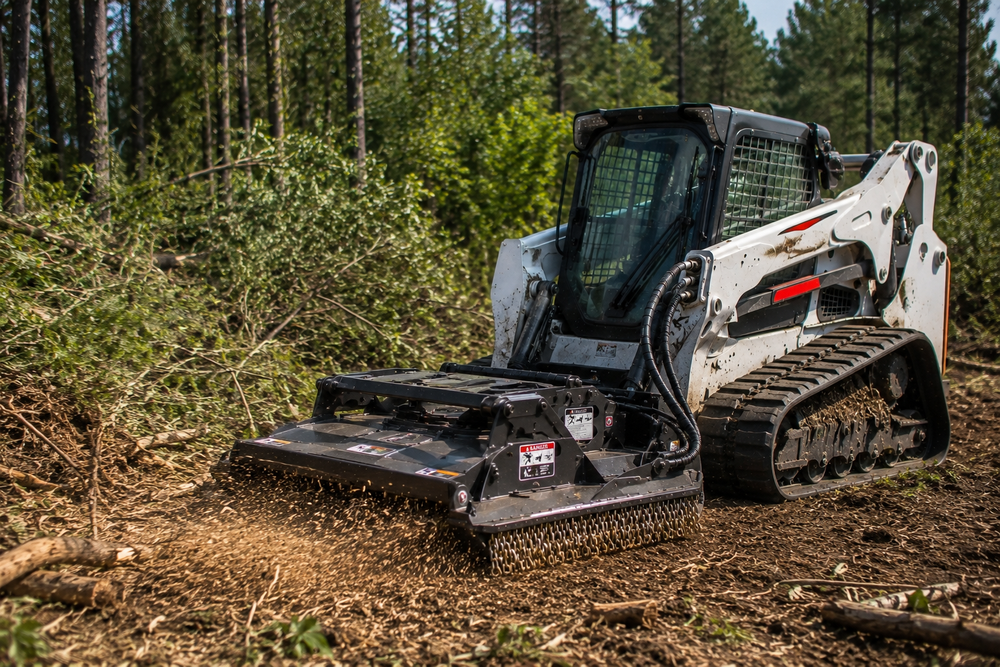
If a place is totally swamped, with thick brush and saplings everywhere, you can’t really do it slowly; you want raw, destructive speed. Overgrown property upkeep really calls for something that both slices and grinds at the same time, not one thing then the other.
- Skid Steer Brush Cutter: It uses thick swinging blades to mow down dense weeds plus small trees pretty fast.
- Forestry Mulchers: Yeah, these are like the top-tier clearing gadgets for turning standing growth into sawdust, basically one smooth shredding move.
- Tree Shears: They clamp and snap trunks right down at the dirt line, without flinging risky chunks around.
A dedicated brush-cutting add-on depends on serious flywheel weight so it stays spinning through stubborn oak or pine. Just make sure your skid steer is set up with high-flow hydraulics to push it along, or the blades will bog down the moment you run into a real tree.
Managing Loose Sand and Dust
Sand seems easy until you realize it acts like sandpaper. Fine grit gets into every single moving joint and destroys your equipment from the inside out.
- Standard Shovels: Good for moving piles, but they will not prep a seedbed.
- Skid Steer Rototiller for Sale: Grab a heavy tiller to grind up and mix dry, sandy ground.
- Power Box Rakes: These use spinning teeth to windrow rocks while leaving behind smooth, clean topsoil.
Dry terrain requires specific soil preparation equipment. You are trying to stabilize the ground, not just smash trees. Make sure your gear has fully sealed bearings, or the flying dust will turn your grease into grinding paste and ruin your shafts.
Working on Steep Hillside Slopes
Gravity changes everything when you start working on a steep incline. The weight of your tool can easily tip your loader over if you get careless.
- Articulating Decks: These let you tilt the blades to match the hill while your machine stays flat.
- Lightweight Heads: Keeps the front end light so your back tires stay glued to the dirt.
- Excavator Booms: Let you clear steep banks from a completely safe, flat position.
Always change your land clearing methods when dealing with hills. Work straight up and down, never sideways across the face. Using an articulating cutter lets you reach down into nasty ditches while keeping your machine on safe, level ground.
Getting the Right Gear
At Spartan Equipment, we build land clearing tools that do not quit when the ground gets ugly. We know that downtime kills your profit margins faster than anything else. That is why we use high-strength American steel and top-grade components that actually survive real-world abuse. From dense woods to rocky flats, we build the rugged attachments you need to tackle any terrain without breaking your machine.
The Bottom Line
You cannot change the dirt on the job site, but you can change the tool on your loader. Check the ground before you quote the work, match your hydraulic flow, and use the right attachment for the soil.
Frequently Asked Questions
What type of attachment works best for rocky terrain?
When facing rocky ground, you need attachments built for high-impact punishment. Spartan Equipment has heavy-duty rock buckets and grapples that use reinforced steel tines to sift out soil while also gathering heavy stones. Usual steel blades will crack on granite, so you have to use a heavy-duty brush-cutting attachment fitted with carbide teeth, because accidental rock strikes will otherwise ruin your cutting edge.
Which attachments hit hardest in dense vegetation?
For thick brush and heavy saplings, you want high-velocity tools that can process wood fast. A heavy forestry mulcher, or an industrial skid steer brush cutter, works best here. They run on heavy spinning discs or drums that chop through the dense growth and turn standing trees into organic mulch in a single pass, so you do not keep hauling debris away.
How do soil conditions impact land clearing efficiency?
Soil type directly controls your daily ground speed and fuel burn. Wet, sticky clay will clog up enclosed cutting decks, bogging down your engine and stalling your blades. On the flip side, dry, sandy conditions create massive amounts of abrasive dust that will choke your engine air filters and destroy unsealed bearings if you neglect daily maintenance.
How can operators improve productivity on challenging terrain?
The best way to stay productive is to kind of match what your machine can handle with the same terrain issues you’re dealing with, not just some general idea. Like if you’re in soft mud, you should use tracked loaders so you don’t end up stuck in that grey muck. And when you’re on steep slopes, think about long-reach excavator attachments, so the machine stays parked on safer ground while you work. Also, keep your blades sharp and check hydraulic pressure every day; it really helps prevent the whole system from overheating, even if it feels a little repetitive and, ugh, kinda too much sometimes.
What is the benefit of using a disc mulcher over a drum mulcher in open fields?
A disc mulcher tends to be built for raw speed in open areas, because the big horizontal discs store up a huge amount of kinetic energy. They chew through brush and smaller trees faster than a drum. Meanwhile, a drum mulcher is the more careful option for fine grooming and working close to fences, but for blasting through large acres quickly, the disc mulcher is pretty much the clear choice.