

Posted by Spartan Equipment on 20th Apr 2026
If you’ve ever hooked up a tool to your skid steer and thought, "Why does this feel underpowered?" chances are you didn’t match the GPM right.
This is one of those things people skip. They buy skid steer attachments based on price, or what someone else is using, and then wonder why it’s not working the same. Truth is, GPM (gallons per minute) is everything when it comes to hydraulic attachments. And yeah, it’s not the most exciting spec to look at. But it’s the difference between a machine that works… and one that struggles every single day. Let’s break it down in a simple way.
What GPM Actually Means (And Why It Matters More Than You Think)
GPM is basically how much hydraulic oil your skid steer can push through an attachment per minute. More flow = more power.
But here’s where people mess up. Not all skid loader attachments need the same flow. Some tools barely need anything. Others, like a skid-steer brush cutter, demand serious hydraulic power to even function properly.
If your machine pushes 15 GPM and your attachment needs 25… It’s not going to magically adjust. It’ll just perform badly. Slow cuts, weak digging, and overheating sometimes. That’s why understanding GPM requirements for skid steer attachments isn’t optional. It’s basic groundwork.
Low Flow vs High Flow Attachments — Don’t Mix Them Up
Most skid steers fall into two categories:
Low flow (usually around 10–20 GPM)
High flow (20–40+ GPM)
Sounds simple, but the confusion starts when people assume “it’ll probably work anyway.” It won’t.
Low-flow attachments are things like:
- Augers for light digging
- Basic buckets
- Some mini skid steer attachments
High-flow attachments are where the real power tools come in:
- Heavy-duty skid steer attachments like forestry mulchers
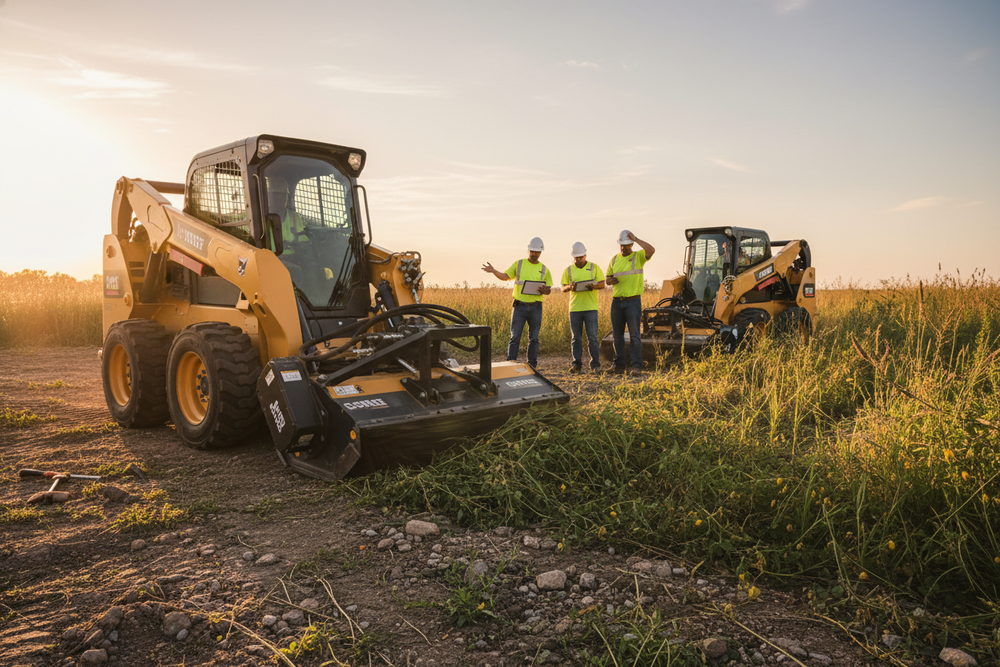
- High-performance skid steer brush cutter
- Advanced trenchers
If you mismatch these, you’ll feel it immediately. The machine sounds like it’s working… but the output is weak. Almost frustrating.
The Real Impact of GPM on Common Attachments
Let’s talk real-world examples. This is where it clicks.
Skid Steer Brush Cutter
A brush cutter is only as good as the hydraulic flow behind it.
If you’re running low GPM:
- Cutting gets uneven
- Thick brush slows everything down
- You’ll spend twice the time on one job
With proper high flow:
- Clean, aggressive cuts
- Handles dense vegetation easily
- Way more efficient
Big difference. Same attachment, totally different result.
Skid Steer Auger Attachment
This one’s interesting. A skid steer auger attachment doesn’t always need high flow, but it does need consistent torque. If GPM is too low, drilling feels sluggish. If it’s too high without control, it can get jerky.
Balance matters here.
You want:
- Smooth rotation
- Enough power for soil conditions
- Control, not just speed
Skid Steer Backhoe Attachment
Now this is where people really get confused. A skid steer backhoe attachment isn’t just plug-and-play. It needs proper hydraulic support to dig efficiently.
If the GPM is off:
- Digging depth feels limited
- Cycle times slow down
- You lose precision
If you’re using a backhoe attachment for a skid steer, you’re doing serious work. Trenching, digging foundations, and utility lines. You don’t want to fight your machine.
Where Most Buyers Go Wrong
Here’s the honest part. Most people buying skid steer attachments don’t check compatibility properly. They just look at:
- Price
- Size
- Maybe brand
That’s it. But the smarter move? Match your machine specs first. Then choose the attachment.
If you’re not sure where to start, platforms like Spartan Equipment make it easier to compare and choose properly without guessing. Because fixing the wrong purchase later… costs more. Always does.
Choosing the Best Skid Steer Attachments
You don’t need to overcomplicate this. Just follow a simple approach.
Start with your machine:
- What’s your hydraulic flow rating?
- Low flow or high flow?
Then think about your work:
- Light-duty or heavy-duty jobs?
- Occasional use or daily operations?
Then match the attachment. The best skid steer attachments aren’t the most expensive ones. They’re the ones that actually work with your machine. Sounds obvious. Still gets ignored.
What About Mini Skid Steer Attachments?
Mini machines are a different story. They usually run lower GPM. So, expecting them to power heavy-duty skid steer attachments is unrealistic.
Mini skid-steer attachments are designed for:
- Tight spaces
- Lighter work
- Controlled tasks
Trying to push them beyond that just leads to frustration.
Best Attachment for Trenching — Quick Insight
If trenching is your main task, you’ve got two common options:
- Trenchers
- Backhoe attachment for skid steer
Trenchers are faster for straight, narrow cuts. Backhoes are more flexible.
But again, it comes down to hydraulic flow. If your GPM is low, trenching will feel slow no matter what you pick. If it’s high flow, everything becomes smoother, faster, and more precise.
Common Mistakes You Should Avoid
A few things people do that cause problems later:
- Buying high-flow attachments for low-flow machines
- Ignoring manufacturer specs
- Assuming all skid loader attachments are universal
- Not considering long-term workload
These don’t feel like big mistakes at first. But they show up later when work slows down, or equipment wears out faster.
One More Thing Before You Buy
Don’t just think about today’s job.
Think about:
- What you’ll be doing 6 months from now
- Whether your machine can handle future upgrades
- If the attachment will still perform under heavier loads
This is where smarter buyers win. If you’re comparing options, Spartan Equipment has a solid range that actually makes sense for different machine types. Worth checking before making a decision you’ll regret later.
Image Alt Tags: backhoe attachment for skid steer
Final Thoughts
Understanding GPM requirements for skid steer attachments isn’t complicated. It’s just overlooked. Match your machine. Match your attachment. That’s it.
When you get it right, everything works better. Faster jobs. Less stress. Better results. When you don’t… You feel it every single day.
Ready to Choose the Right Attachment?
If you want skid steer attachments that actually perform the way they should, don’t guess. Explore reliable, properly matched options at Spartan Equipment.
Because the right setup doesn’t just save time, it makes your machine worth what you paid for it.
FAQs
Why use a backhoe attachment on a skid steer?
One of the most adaptable skid steer attachments that you can have is a backhoe attachment for a skid steer. It enables you to create trenches, foundations, and holes without having to use another machine. To most operators, it is time- and money- and space-saving on the ground, and yet still gives good digging performance.
Are skid steer attachments universal?
Not exactly. Although most skid loader attachments employ a universal mounting system, hydraulic flow, pressure, and machine size continue to determine compatibility. Simply because it is physically fitting does not imply that it will be working properly. Never think that specs can work without a glitch.
How deep can a skid steer backhoe dig?
The majority of skid steer backhoe attachments are able to excavate between 6 and 11 feet deep, depending on the model and hydraulic capacity. But real performance is also a factor of your machine's GPM and pressure as well. The improved flow typically implies smoother functioning and more efficient digging periods.
Can all skid steers use a backhoe attachment?
No, not every skid steer can be used with every backhoe attachment. You must be similar in terms of hydraulics requirements, weight capacity, and mounting. Smaller or low-flow machines might not cope with heavier hydraulic backhoe attachment models, becoming poorly performing or not working.
What should I check before buying a backhoe attachment?
Make sure you check the GPM, hydraulic pressure, and lift capacity of your skid steer before purchasing. Think also of your usual workload depth, soil type, and frequency of use. A discrepancy in this case may cause slowness in digging, overheating, or even damage to equipment over time.